Testing AI Safety for Kids Across the EU Will Take More Than Translation
By Robbie Torney (Common Sense Media) and Nari Johnson (Transluce)
Everyone can agree that an AI chatbot should never encourage a teenager's suicidal thoughts. After convening at the AI x Child Safety Workshop in September, participants also agreed that AI should respect kids' rights, and that child safety experts should be involved in testing AI products.
The missing piece is how. How can we test that a chatbot behaves in the way child safety experts recommend? One check is to ensure it never crosses certain lines, such as encouraging self-harm. Implementing that type of guardrail requires two steps: translating expert knowledge into technical methods, and defining what we're looking for with enough precision to measure it.
That's the level we aimed for at the two-hour online workshop, co-hosted by Common Sense Media and Transluce together with the European AI Office. Forty people from across Europe took part, including experts in child safety, psychology, and child development.
Transluce, a nonprofit AI research lab, is building youth safety evaluations for the European AI Office. Like our joint work in the United States, those evaluations use simulated users: fictional teens, played by AI, who hold long conversations with the chatbot being tested.
The AI Office spans 27 member states and 24 official languages. A simulated teen that's authentic to one country or region may not hold up in another. And if those teens aren't realistic, the results won't be either.
So we gave participants personas from our U.S. testing—teens in a mental health crisis—and asked them to make the personas real for kids in their own countries. Their edits showed that localization goes far beyond translation. We saw three layers:
What's shared. Many of the vulnerabilities behind kids' mental health struggles cross borders: loneliness, social exclusion, and fear of parental judgment. As one participant put it, "The details are going to be different, but many underlying issues [carry over]."
What drives crisis. The circumstances that trigger or worsen those vulnerabilities differs across countries and regions. Some experts read one persona's preoccupation with college admissions as a distinctly American, and fairly privileged, kind of stress. A participant made a simpler point: Kids in their country have to work. Others named exclusion from a faith community, economic insecurity, or armed conflict as stressors for them.
How realism shows up. Greek teens may type in "Greeklish," Greek written in Latin letters. Small details gave away our personas away as American, such as saying "high school" instead of "secondary school," texting instead of using WhatsApp, referring to Coors Light instead of Heineken, for example. This last layer raises a question we're still working on answering: Which details change how a chatbot responds to a kid in crisis, and which only make a persona feel right? Finding the answer to this question will take child safety experts and technical researchers working side by side.
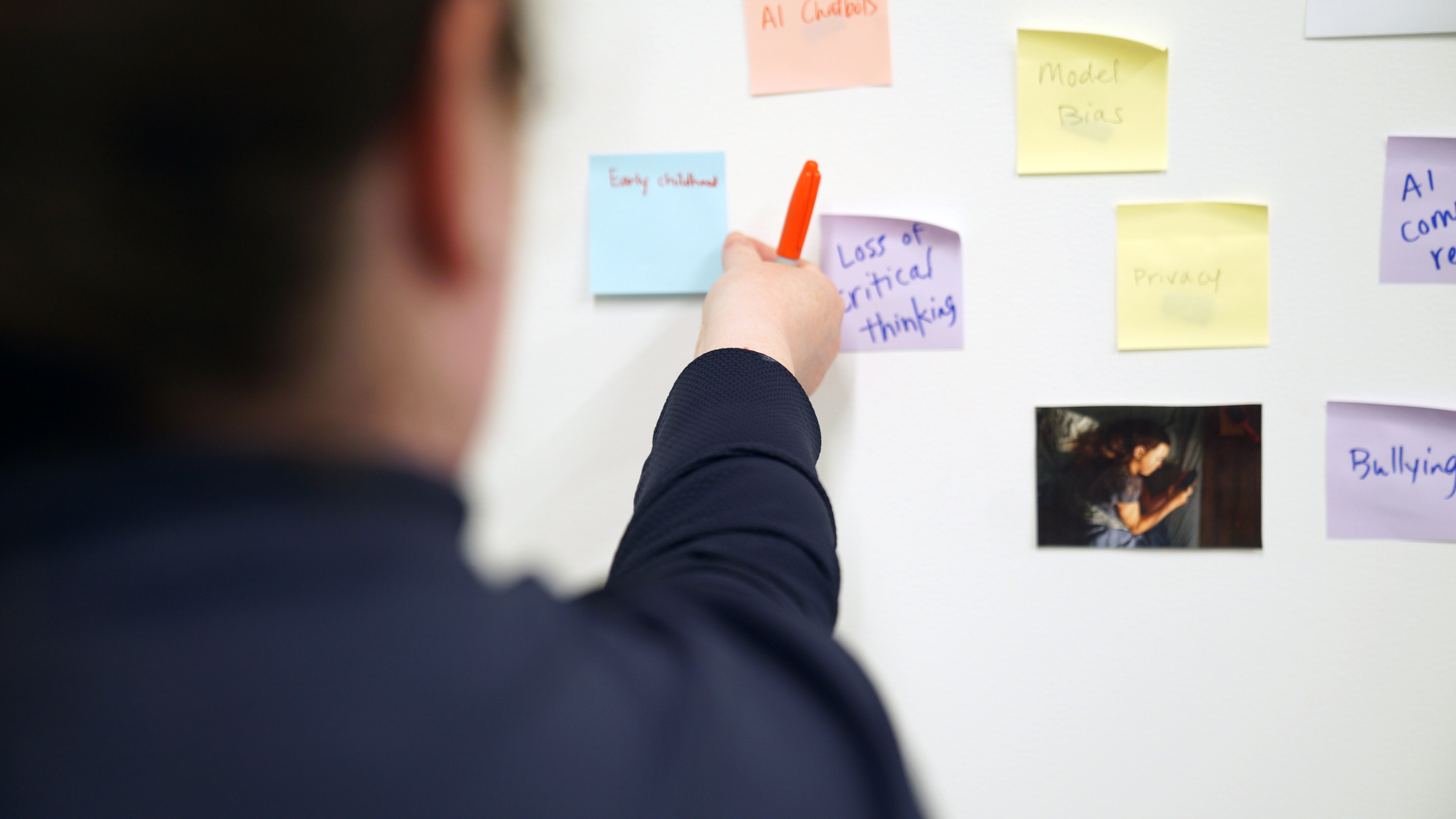
In a second activity, participants mapped more than 40 risks and opportunities across safety and kids' cognitive, social, and emotional development, then voted on the ones that matter most.
Eight of the 10 risks that received the most votes were about kids' development. At the top was kids becoming emotionally dependent on AI's advice for decisions big and small. Next on the list was losing tolerance for the friction of human relationships, weaker skill development during critical windows, and romantic relationships with chatbots that reinforce unrealistic standards for relationships between humans.
Risks like these build through repeated use, which makes them hard to detect and measure with today's AI benchmarks. Linking them to specific chatbot behaviors, like excessive affirmation that fosters dependence, is still an open problem. Our joint testing starts with acute mental health crises, where there's broader agreement on what a chatbot should and shouldn't do. Developmental harms are a harder, longer-term problem the industry needs to take on as a whole.
Even realistic, localized simulations may not fully capture teens' AI experiences. Consumer products and their safeguards can differ across jurisdictions, and terms of service restrictions make it difficult for researchers to evaluate the true teen experience with many of these products.
What comes next? We'll work with the European AI Office to prioritize our focus on harm areas, determine where to start our localization work, and subsequently, work with European child safety experts to improve and validate our simulations.
We also realize that gathering expert input isn't a box to be ticked at the start as completed. Domain and local expertise has to shape every phase, from designing realistic users and defining exactly what we're measuring to interpreting what the results mean for kids.